
Superradiant atoms could push the boundaries of how precisely time can be measured
22.4.2024 14:22:28 CEST | Københavns Universitet | Pressemeddelelse
Superradiant atoms can help us measure time more precisely than ever. In a new study, researchers from the University of Copenhagen present a new method for measuring the time interval, the second, mitigating some of the limitations that today’s most advanced atomic clocks encounter. The result could have broad implications in areas such as space travel, volcanic eruptions and GPS systems.
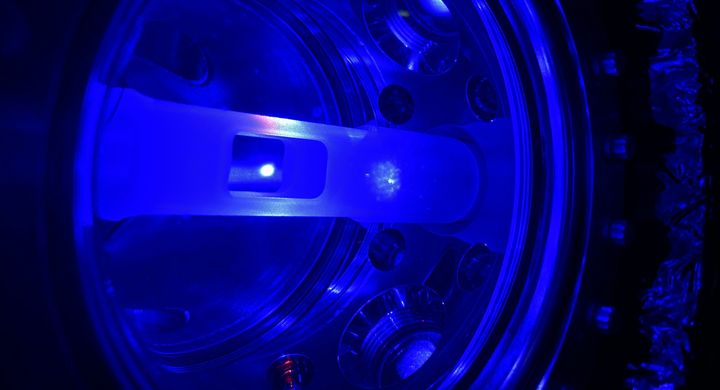
The second is the most precisely-defined unit of measurement, compared to other base units such as the kilogram, meter, and degree Kelvin. Time is currently measured by atomic clocks in different places around the world, which together, tell us what time it is. Using radio waves, atomic clocks continuously send signals that synchronize our computers, phones and wristwatches.
Oscillations are the key to keeping time. In a grandfather clock, these oscillations are from a pendulum's swinging from side to side every second, while in an atomic clock, it is a laser beam which corresponds to an energy transition in strontium and oscillates about a million billion times per second.
But according to PhD fellow Eliot Bohr from the Niels Bohr Institute – great-grandson of Niels Bohr – even atomic clocks could become more precise. This is because the detection laser, used by most modern atomic clocks to read the oscillation of atoms, heats up the atoms so much that they escape – which degrades precision.
"Because the atoms constantly need to be replaced with fresh new atoms, while new atoms are being prepared, the clock loses time ever so slightly. Therefore, we are attempting to overcome some of the current challenges and limitations of the world’s best atomic clocks by, among other things, reusing the atoms so that they don’t need to be replaced as often," explains Eliot Bohr who was employed at the Niels Bohr Institute when he did the research, but who is now PhD fellow at the University of Colorado.
He is the lead author of a new study published in the scientific journal Nature Communicationswhich uses an innovative and perhaps more efficient way of measuring time.
Superradiance and cooling to absolute zero
The current methodology consists of a hot oven that spits roughly 300 million strontium atoms into an extraordinarily chilly ball of cold atoms known as a magneto-optical trap, or MOT. The temperature of these atoms is approximately -273 °C – very near absolute zero – and there are two mirrors with a light field in between them to enhance the atomic interactions. Together with his research colleagues, Bohr has developed a new method to read out the atoms.
"When the atoms land in the vacuum chamber, they lie completely still because it is so cold, which makes it possible to register their oscillations with the two mirrors at opposing ends of the chamber," explains Eliot Bohr.
The reason why the researchers don’t need to heat the atoms with a laser and destroy them is thanks to a quantum physical phenomenon known as 'superradiance'. The phenomenon occurs when the group of strontium atoms is entangled and at the same time emits light in the field between the two mirrors.
"Themirrors cause the atoms to behave as a single unit. Collectively, they emit a powerful light signal that we can use to read out the atomic state, a crucial step for measuring time. This method heats up the atoms minimally, so it all happens without replacing the atoms, and this has the potential to make it a more precise measurement method," explains Bohr.
GPS, space missions and volcanic eruptions
According to Eliot Bohr, the new research result may be beneficial for developing a more accurate GPS system. Indeed, the roughly 30 satellites that constantly circle Earth and tell us where we are need atomic clocks to measure time.
"Whenever satellites determine the position of your phone or GPS, you are using an atomic clock in a satellite. The precision of the atomic clocks is so important that If that atomic clock is off by a microsecond, it means an inaccuracy of about 100 meters on the Earth’s surface," explains Eliot Bohr.
Future space missions are another area where the researcher foresees more precise atomic clocks making a significant impact.
"When people and crafts are sent out into space, they venture even further away from our satellites. Consequently, the requirements for precise time measurements to navigate in space are much greater," he says.
The result could also be helpful in the development of a new generation of smaller, portable atomic clocks that could be used for more than "just" measuring time.
"Atomic clocks are sensitive to gravitational changes and can therefore be used to detect changes in Earth's mass and gravity, and this could help us predict when volcanic eruptions and earthquakes will occur," says Bohr.
Bohr emphasizes that while the new method using superradiant atoms is very promising, it is still a "proof of concept" which needs further refinement. .
The research was conducted by the team of Jörg Helge Müller and Jan Thomsen at the Niels Bohr Institute, in collaboration with PhD students Sofus Laguna Kristensen and Julian Robinson-Tait, and postdoc Stefan Alaric Schäffer. The project also included contributions from theorists Helmut Ritsch and Christoph Hotter from the University of Innsbruck, as well as Tanya Zelevinsky from Columbia University. This work underscores the importance of international collaboration in the sciences.
Contact:
Eliot Bohr
Postdoctoral fellow
Niels Bohr Institute
University of Copenhagen
Eliot.Bohr@nbi.ku.dk
+45 42 68 86 78.
Michael Skov Jensen
Journalist and team coordinator
The Faculty of Science
University of Copenhagen
msj@science.ku.dk
+ 45 93 56 58 97
Følg pressemeddelelser fra Københavns Universitet
Skriv dig op her, og modtag pressemeddelelser på e-mail. Indtast din e-mail, klik på abonner, og følg instruktionerne i den udsendte e-mail.
Flere pressemeddelelser fra Københavns Universitet
Ekstremismens to ansigter: Derfor støtter nogle mennesker vold mellem grupper31.3.2026 05:00:00 CEST | Pressemeddelelse
Menneskers tilbøjelighed til at støtte vold mod andre grupper skyldes ikke en enkelt tankegang: To grundlæggende motivationer og forskellige personlighedstræk er afgørende for volden. Det afslører en ny videnskabelig undersøgelse, der omfatter 58 lande.
4.000 år gamle lertavler gemte på magiske besværgelser… og ølregninger30.3.2026 08:28:11 CEST | Pressemeddelelse
På Nationalmuseet har der i over 100 år ligget en stor samling skrifttavler fra de tidligste civilisationer i Mellemøsten – mange over 4.000 år gamle og skrevet på nu uddøde sprog. Tavlerne har levet et stille liv, men nu har forskere tydet dem og fundet fascinerende tekster om magi, konger og godt gammeldags bureaukrati.
Drenge dropper bøgerne, når skolen holder lukket – piger bliver ved med at læse27.3.2026 08:56:13 CET | Pressemeddelelse
Når en ferie eller en pandemi lukker skolen, forstærker det kønsforskellene i børns læsning: Drengene falder fra, mens pigerne fortsætter med at læse, viser et nyt studie fra Københavns Universitet. Det peger på, at drenge er mere afhængige af skolens faste rutiner og forventninger, mener forskerne.
Fugleinfluenza truer danske kvæg. Nyt værktøj kan advare landmænd, før smitten spredes19.3.2026 07:00:00 CET | Pressemeddelelse
Fugleinfluenza kan smitte både køer og mennesker. Forskere fra Københavns Universitet har udviklet et værktøj, som kan forudse, hvor og hvornår smitterisikoen er størst.
Fortidens massive hvalfangst truer fremtidens grønlandshvaler17.3.2026 16:00:00 CET | Pressemeddelelse
Kommerciel hvalfangst har gjort grønlandshvalen sårbar 1.000 år ud i fremtiden.
I vores nyhedsrum kan du læse alle vores pressemeddelelser, tilgå materiale i form af billeder og dokumenter samt finde vores kontaktoplysninger.
Besøg vores nyhedsrum